Best Dual-Tank Water Softeners in 2026
Best dual-tank (twin alternating) water softeners for 24/7 uninterrupted soft water. Fleck 9100SXT and other top systems compared for 2026.
In this guide
Standard single-tank water softeners have one limitation that most people don’t think about until it matters: during regeneration, the system bypasses hard water into your home for 60-90 minutes. If someone showers during regeneration, they get hard water. If the dishwasher runs during regeneration, it gets hard water. For most households, this is a minor inconvenience — you set regeneration for 2 AM and never notice. But for large families, shift workers, businesses, or anyone who needs guaranteed soft water 24/7, a dual-tank (twin alternating) system eliminates this gap entirely.
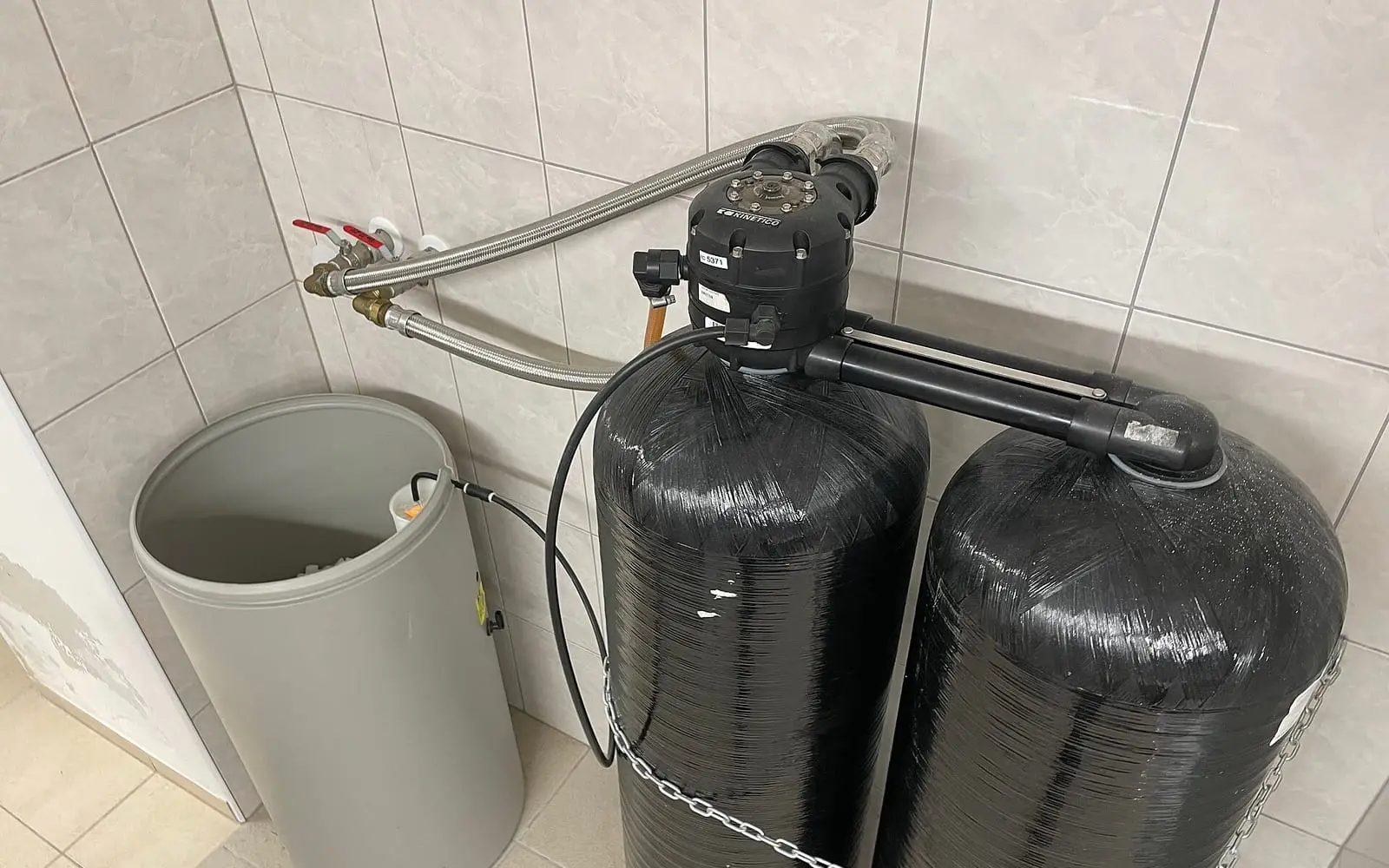
Dual-tank softeners use two resin tanks connected to a single control valve. While one tank is in service softening water, the other is either on standby or regenerating. When the active tank’s resin is exhausted, the valve automatically switches to the standby tank — providing continuous soft water without interruption. The exhausted tank then regenerates while the fresh tank takes over. You never have a moment of hard water, period.
Our Top Picks
1. Fleck 9100SXT 48K per Tank (96K Total) — Best Overall Dual-Tank
The Fleck 9100SXT is the industry standard for dual-tank residential softeners. The 9100 series valve is specifically designed for twin alternating operation — it manages two resin tanks, tracks capacity on each tank independently, and switches between them automatically based on demand. With 48,000 grains per tank (96,000 total), this system handles large families with very hard water without breaking a sweat.
The metered control tracks actual water usage and switches tanks when the active tank approaches exhaustion — not on a timer. This means the standby tank is always ready with fresh resin. The Fleck 9100SXT valve has been in production for over a decade with a strong reliability record. Parts are widely available from water treatment suppliers. Pentair backs it with a 5-year valve warranty and 10-year tank warranty.
What we like
- 96,000 total grain capacity (48K per tank) — handles extreme demand
- Continuous 24/7 soft water — zero hard water during regeneration
- Fleck 9100SXT valve — proven dual-tank technology with wide parts availability
- Metered alternating regeneration for maximum efficiency
- Each tank regenerates independently — always a fresh tank ready
- Available in multiple capacity configurations (24K-80K per tank)
Trade-offs
- Large footprint — two full resin tanks plus brine tank
- Premium price ($1,500-$2,200 for 48K per tank configuration)
- More complex installation than single-tank systems
- Fleck 9100SXT valve is more complex — fewer technicians familiar with it
- Higher salt consumption than single-tank systems (two tanks regenerating)
- 5-year valve warranty (not lifetime)
2. AFWFilters Fleck 9100SXT 64K per Tank (128K Total) — Best High-Capacity Dual
For households with extreme hardness or very high water usage, AFWFilters offers the Fleck 9100SXT with 64,000 grains per tank — 128,000 grains total. This is the highest-capacity residential dual-tank configuration commonly available. Each tank contains 2 cubic feet of high-capacity resin. The system handles families of 6+ with hardness above 25 GPG.
AFWFilters also offers this system with fine mesh resin for well water with iron, or with 10% crosslink resin for enhanced durability. The Iron Pro 2 dual-tank variant combines softening and iron removal in each tank. At $1,800-$2,500, it’s a significant investment, but for extreme water conditions, the 128K total capacity provides the longest intervals between regenerations and the most consistent water quality.
What we like
- 128,000 total grain capacity — highest available for residential use
- Available with fine mesh resin (iron removal) or 10% crosslink (durability)
- Iron Pro 2 variant handles iron up to 6-8 ppm per tank
- Fleck 9100SXT valve — proven technology
- Longest intervals between regenerations
- Available on Amazon with fast shipping
Trade-offs
- Largest footprint of any residential softener
- Highest price ($1,800-$2,500)
- Heaviest system — difficult to install without help
- Maximum salt consumption
- DIY installation required — complex plumbing
- Overkill for moderate hardness or small households
3. Fleck 9100SXT 24K per Tank (48K Total) — Best Compact Dual-Tank
Not every household that needs 24/7 soft water has extreme hardness or a large family. The Fleck 9100SXT with 24,000 grains per tank (48,000 total) provides continuous soft water in a smaller package. Each tank contains 0.75 cubic feet of resin in a 9” × 48” tank — significantly smaller than the 48K or 64K configurations.
This configuration works well for 2-4 person households with moderate to hard water (7-20 GPG). The smaller tanks mean less space required — important for homes with limited utility areas. At $1,200-$1,600, it’s the most affordable dual-tank option. The trade-off is more frequent alternation between tanks, but with metered control, the system manages this automatically and efficiently.
What we like
- Continuous 24/7 soft water in a smaller package
- 48,000 total grain capacity handles most moderate households
- Smaller tanks (9" × 48") — fits in tighter spaces than larger dual systems
- Most affordable dual-tank option ($1,200-$1,600)
- Same proven Fleck 9100SXT valve technology
- Good balance of continuous soft water and space efficiency
Trade-offs
- 24K per tank may require frequent alternation with hard water
- Not suitable for very hard water (25+ GPG) or large families (5+)
- Still larger footprint than a single-tank system
- Higher cost than a single-tank system of equivalent total capacity
- More complex than single-tank installation
- Smaller brine tank may need more frequent salt refills
4. Clack WS1.25 Dual-Tank — Best Alternative to Fleck
Clack is the second most popular control valve brand in residential water treatment, and the WS1.25 is their dual-tank alternating valve. It’s a legitimate alternative to the Fleck 9100SXT with some advantages: the Clack valve uses a simpler internal design with fewer moving parts, which some water treatment professionals prefer for long-term reliability. The WS1.25 also offers slightly higher flow rates than the Fleck 9100SXT in some configurations.
Clack dual-tank systems are typically sold through water treatment dealers rather than direct-to-consumer online retailers. This means you’ll often get professional sizing, installation, and ongoing support — but at a higher total cost. Pricing varies by dealer but typically runs $1,800-$3,000 for a complete dual-tank system with installation. For buyers who want professional support and an alternative to Fleck, Clack is the top choice.
What we like
- Simpler internal valve design — fewer moving parts than Fleck 9100SXT
- Strong reputation among water treatment professionals
- Higher flow rates in some configurations
- Available through professional dealers with installation support
- Robust build quality
- Good parts availability through water treatment supply channels
Trade-offs
- Typically sold through dealers — higher total cost with installation
- Less widely available online than Fleck systems
- Fewer consumer reviews and online resources
- Dealer pricing varies significantly by region
- Less familiar to general plumbers (vs Fleck's ubiquity)
- May require dealer for service and parts
Comparison Table
| Model | Capacity (per tank) | Total Capacity | Valve | Best For | Price |
|---|---|---|---|---|---|
| Fleck 9100SXT 48K | 48,000 grain | 96,000 grain | Fleck 9100SXT | Large families, hard water | $1,500-2,200 |
| AFWFilters 9100SXT 64K | 64,000 grain | 128,000 grain | Fleck 9100SXT | Extreme hardness, high usage | $1,800-2,500 |
| Fleck 9100SXT 24K | 24,000 grain | 48,000 grain | Fleck 9100SXT | Small-medium homes, 24/7 need | $1,200-1,600 |
| Clack WS1.25 Dual | Varies (dealer configured) | Varies | Clack WS1.25 | Professional installation | $1,800-3,000 |
How Dual-Tank Alternating Systems Work
Understanding the alternating cycle helps you appreciate why dual-tank systems provide superior water quality:
- Tank A is in service: All household water flows through Tank A’s resin bed, removing hardness minerals through ion exchange. Tank B is on standby with fully regenerated resin.
- Tank A approaches exhaustion: The metered control valve tracks how much water has passed through Tank A and calculates remaining capacity based on your programmed hardness level.
- Automatic switchover: When Tank A’s capacity is nearly depleted, the valve automatically switches water flow to Tank B. This happens instantly — no interruption in soft water supply.
- Tank A regenerates: While Tank B is now in service, Tank A goes through its regeneration cycle (backwash, brine draw, slow rinse, fast rinse). This takes 60-90 minutes.
- Tank A returns to standby: After regeneration, Tank A is fully recharged and waits on standby until Tank B needs to be replaced.
- Cycle repeats: The tanks alternate indefinitely, each one regenerating only when needed based on actual water usage.
The key advantage: at no point during this cycle does hard water enter your home. One tank is always in service with fresh resin while the other regenerates or waits on standby.
Who Actually Needs a Dual-Tank System?
Dual-tank systems are a premium investment. Here’s who genuinely benefits:
- Large families (5+ people): With high water usage, a single-tank system may need to regenerate during peak hours. A dual-tank system eliminates this concern.
- Very hard water (25+ GPG): High hardness means more frequent regeneration. Dual tanks ensure one is always ready.
- Shift workers or irregular schedules: If someone is always home and using water at all hours, scheduling regeneration during “off” hours is impossible.
- Home businesses: Hair salons, laundromats, car detailing, and other water-intensive businesses need consistent water quality.
- Medical equipment: CPAP machines, humidifiers, and other medical devices that use water benefit from consistent soft water.
- Perfectionist water quality: If even occasional hard water during regeneration is unacceptable to you, dual-tank is the only solution.
Who Doesn’t Need a Dual-Tank System?
Most households don’t need dual-tank systems. If you can schedule regeneration for 2-3 AM when no one uses water, a single-tank system provides soft water 99%+ of the time at significantly lower cost. A single-tank Fleck 5600SXT 48K costs $600-$900 vs $1,500-$2,200 for a dual-tank 9100SXT. The price premium for dual-tank is only justified if you genuinely need 24/7 uninterrupted soft water.
Frequently Asked Questions
Q: Do dual-tank softeners use more salt than single-tank systems?
Not necessarily more salt per gallon of water softened — but the total salt consumption is higher because you’re maintaining two resin beds. Each tank regenerates independently when its capacity is depleted. The metered control ensures each regeneration uses only the salt needed for the actual hardness removed. In practice, a dual-tank system uses approximately 10-20% more salt than a single-tank system of equivalent per-tank capacity, because the alternating cycle sometimes triggers regeneration before a tank is fully exhausted.
Q: Can I convert a single-tank softener to dual-tank?
No — you can’t simply add a second tank to a single-tank valve. The Fleck 5600SXT (single-tank) and Fleck 9100SXT (dual-tank) are completely different valves with different internal configurations. Converting requires replacing the entire valve and adding a second tank. At that point, you’re essentially buying a new dual-tank system. If you think you might want dual-tank capability in the future, buy the 9100SXT from the start.
Q: How much space do I need for a dual-tank system?
A dual-tank system with 48K per tank typically requires approximately 36” × 24” of floor space for the two resin tanks, plus an additional 18” × 18” for the brine tank. Total footprint: roughly 36” × 42” minimum, plus clearance for plumbing connections and maintenance access. This is approximately twice the footprint of a single-tank system. Ensure your utility area can accommodate the larger installation before purchasing.
Q: Are dual-tank systems harder to maintain?
Day-to-day maintenance is identical to single-tank systems — add salt to the brine tank periodically and replace the sediment pre-filter. The dual-tank valve handles all alternation and regeneration automatically. The only additional complexity is during installation (more plumbing connections) and if the valve needs service (the 9100SXT is more complex than the 5600SXT). For routine operation, dual-tank systems are just as hands-off as single-tank systems.
The Bottom Line
The Fleck 9100SXT with 48,000 grains per tank is the best dual-tank softener for most households that need 24/7 soft water. It provides 96,000 grains of total capacity with the most proven dual-tank valve in the industry. For extreme conditions, the AFWFilters 64K per tank configuration offers 128,000 grains total. For smaller homes, the 24K per tank configuration provides continuous soft water in a more compact package.
Before investing in a dual-tank system, honestly assess whether you need one. If you can schedule regeneration during sleeping hours and no one in your household uses water at 2-3 AM, a single-tank system at half the cost will serve you just as well 99% of the time.
Specs and prices are checked against manufacturer documentation and current retail listings at the time of writing and can change. Read how we test and our editorial policy. Spotted an error? Tell us.