When to Start Childproofing: Age-by-Age Guide (2026)
When to start childproofing your home — a developmental timeline from pregnancy through age 3, with specific hazards and solutions for each stage.

In this guide
The most common childproofing mistake is waiting until after an incident to act. Parents typically childproof reactively — the baby reaches for an outlet, so they buy outlet covers; the toddler opens the cabinet under the sink, so they install cabinet locks. The problem with reactive childproofing is that it relies on catching the hazard before the child does, and children are faster learners than most parents expect. The better approach is proactive childproofing: staying one developmental stage ahead of your child’s abilities.
This guide maps childproofing tasks to developmental milestones, so you know what to do before your baby can do what you’re protecting against.
Before Birth / First Month
This is the ideal time for the big installations — the ones that require tools, noise, and time you won’t have once the baby arrives.
What to Do Now
Install smoke detectors and carbon monoxide detectors on every level of the home and inside every bedroom. Test existing detectors and replace batteries. The CPSC recommends replacing smoke detectors every 10 years — check the manufacture date on the back.
Anchor heavy furniture to walls. Dressers, bookshelves, TV stands, and any tall furniture should be secured with anti-tip straps. This is the single most important childproofing step you can take — furniture tip-overs kill an average of 11 children per year in the US, and the risk begins as soon as the child can pull up on furniture (around 8-10 months). Do it now while you have time and energy.
Set the water heater to 120°F. At the default 140°F, water causes third-degree burns in 5 seconds. At 120°F, it takes 5 minutes — enough time to react. This protects the entire household, not just the baby.
Install stair gates if you have stairs. Hardware-mount gates at the top, pressure-mount or hardware-mount at the bottom. Even though the baby won’t be mobile for months, having gates installed means they’re ready when mobility arrives — which happens faster than you expect.
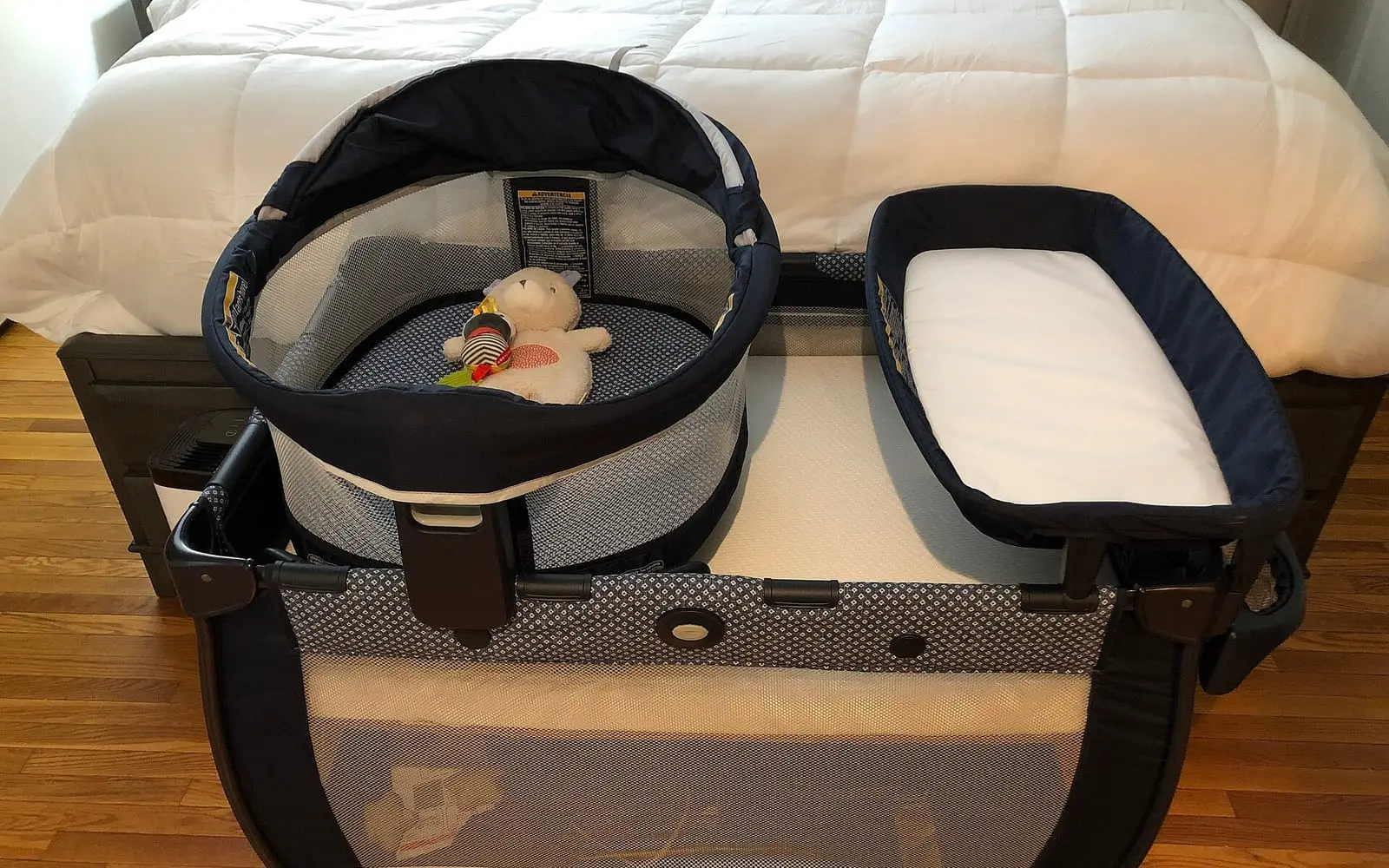
Set up the nursery safely. Crib meets current CPSC standards, firm mattress, no loose items in the crib. Crib positioned away from windows, cords, and shelves. Furniture anchored. Outlet covers installed.
1-3 Months: Reaching and Grasping
Babies begin reaching for objects and grasping by 2-3 months. Their reach is limited to arm’s length, but anything within that radius is going in their mouth.
New Abilities
Reaching and grasping objects. Bringing objects to mouth. Beginning to roll (some babies roll as early as 2 months). Increased visual tracking — they notice things across the room.
What to Do
Remove small objects from any surface near where the baby lies or sits. The choking hazard test: if it fits inside a toilet paper roll, it’s a choking hazard for children under 3. This includes coins, buttons, small toy parts, batteries (especially button batteries), and decorative items.
Secure dangling cords. Blind cords, lamp cords, and phone charger cables within reach of the crib, changing table, or play mat are strangulation hazards. Use cord cleats, cord covers, or switch to cordless blinds.
Check the crib environment. As the baby begins to move, ensure nothing is within reaching distance of the crib — mobiles should be high enough that the baby can’t grab them, and no items should be draped over the crib rail.
4-6 Months: Rolling and Sitting
Babies roll both directions by 4-5 months and begin sitting with support by 5-6 months. Their world expands from a fixed point to a small radius around wherever they’re placed.
New Abilities
Rolling from back to front and front to back. Sitting with support, then independently. Reaching farther and with more accuracy. Transferring objects between hands. Everything goes in the mouth.
What to Do
Never leave the baby unattended on elevated surfaces. Changing tables, beds, couches, and counters are fall risks now that the baby can roll. Always use the changing table strap, and keep one hand on the baby at all times.
Cover electrical outlets in all rooms the baby uses. Plate-style covers (Safety 1st OutSmart) are more effective than plug-in caps, which babies will eventually learn to remove.
Begin locking cabinets containing hazardous materials. Under-sink cabinets in the kitchen and bathroom contain cleaning chemicals, and the baby will be crawling toward them within weeks. Install magnetic cabinet locks now.
Remove tablecloths and runners. A sitting baby who grabs a tablecloth can pull heavy objects (dishes, hot drinks, vases) down onto themselves.
6-9 Months: Crawling
This is the stage where childproofing becomes urgent. A crawling baby covers ground quickly and is drawn to exactly the things you don’t want them to touch — outlets, cords, cabinet doors, stairs, and anything on the floor.
New Abilities
Crawling (army crawl, then hands-and-knees). Pulling up to kneeling. Opening cabinet doors and drawers. Picking up small objects with improving pincer grasp. Exploring every accessible space.
What to Do
Get on your hands and knees and crawl through every room the baby has access to. Look at the world from their perspective. You’ll notice hazards you never saw from standing height — small objects under furniture, exposed outlets behind chairs, sharp edges at face level, and accessible cords.
Verify stair gates are installed and functioning. If you haven’t installed them yet, do it immediately — a crawling baby can reach stairs in seconds.
Install corner protectors on coffee tables, end tables, and hearth edges. A crawling baby who pulls up and falls hits these edges at head height.
Lock all accessible cabinets and drawers. Not just the ones with chemicals — drawers with sharp utensils, heavy pots, plastic bags, and small objects all need locks. Designate one “safe” cabinet with baby-appropriate items (plastic containers, wooden spoons) to satisfy the urge to explore.
Secure floor-level hazards. Move poisonous houseplants to high shelves. Pick up shoes (small parts, choking hazard). Secure floor lamps that can be pulled over. Block access to pet food and water bowls.
9-12 Months: Pulling Up and Cruising
Babies pull up on furniture and “cruise” (walk while holding onto furniture) between 9-12 months. Their reach extends to tabletop height, and their mobility increases dramatically.
New Abilities
Pulling to standing. Cruising along furniture. Climbing onto low furniture. Opening doors (lever handles). Improved fine motor skills — can manipulate latches and buttons. Beginning to walk independently (some babies).
What to Do
Install toilet locks. A standing baby can lean over the toilet rim — drowning risk in as little as 1 inch of water.
Add door knob covers or lever handle locks to off-limits rooms (bathroom, garage, laundry room, home office).
Reassess furniture stability. A baby pulling up on a bookshelf, TV stand, or dresser applies significant force. Verify all anti-tip straps are secure. Remove items from low shelves that could fall on the baby or be pulled down.
Install window guards or stops on upper-floor windows. A baby who can pull up can reach window sills. Windows should not open more than 4 inches. Screens are not strong enough to prevent falls.
Move chairs away from counters and tables. A climbing baby uses chairs as stepping stones to reach higher surfaces.
12-18 Months: Walking and Climbing
Walking toddlers are fast, curious, and increasingly capable of defeating simple childproofing measures. This is the stage where you upgrade from basic to advanced childproofing.
New Abilities
Walking independently. Climbing stairs, furniture, and anything with footholds. Opening containers and simple latches. Throwing objects. Running (by 15-18 months). Increased problem-solving — they remember where interesting things are and figure out how to reach them.
What to Do
Upgrade outlet covers if the child has defeated the current ones. Switch from plug-in caps to plate-style covers with more complex release mechanisms.
Reassess all childproofing from the child’s new height and capability. A walking toddler can reach higher, move faster, and solve problems that a crawling baby couldn’t. Walk through the house and identify anything newly accessible.
Secure the stove. Install stove knob covers and consider a stove guard. A toddler who can reach the stove can turn on burners.
Lock the dishwasher. Sharp utensils and detergent pods are accessible when the door is open.
18-36 Months: Problem-Solving and Testing Limits
Toddlers in this age range actively test childproofing measures. They remember that the cabinet was locked yesterday and try again today with a different approach. They watch adults open locks and attempt to replicate the motion. Childproofing at this stage is an ongoing process of observation and adaptation.
What to Do
Observe your child’s attempts to defeat childproofing and upgrade accordingly. If they’ve figured out the cabinet lock, switch to a more complex mechanism. If they can climb the baby gate, switch to a taller gate or a hardware-mount gate they can’t push out.
Begin teaching safety rules alongside physical barriers. “Hot — don’t touch” and “we don’t climb on that” start to have meaning at this age. Childproofing products buy time for these lessons to take hold.
Maintain vigilance. The most dangerous period is when parents relax childproofing because the child “knows better.” Toddlers understand rules inconsistently and forget them when excited or curious. Physical barriers remain necessary until at least age 3-4 for the most dangerous hazards (stairs, chemicals, water).
The Bottom Line
Start childproofing before birth with the major installations (furniture anchoring, smoke detectors, stair gates, water heater adjustment). Stay one stage ahead of your child’s development — install outlet covers before they crawl, cabinet locks before they cruise, and toilet locks before they stand. Childproofing is not a one-time project; it’s an evolving process that adapts as your child grows. The goal is never to make the home perfectly safe — that’s impossible — but to buy yourself the reaction time between your child encountering a hazard and you intervening.
Specs and prices are checked against manufacturer documentation and current retail listings at the time of writing and can change. Read how we test and our editorial policy. Spotted an error? Tell us.